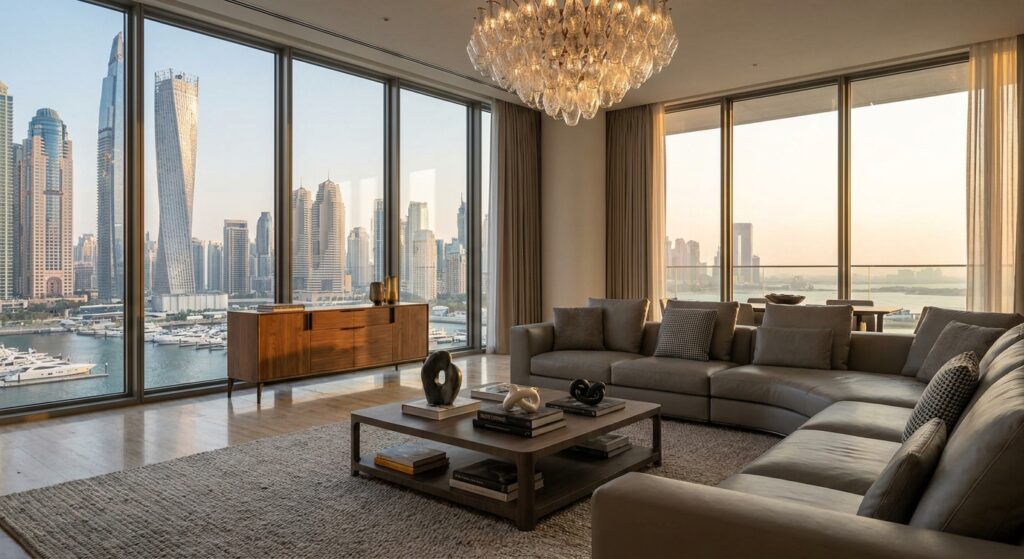
A large blank living room wall looks simple until you choose between artwork, shelving, a mirror, or a permanent finish. The best answer starts with proportion, furniture alignment, light, fixing capacity, and reversibility.
Choose large living room walls decor by proportion before choosing a style
Choose the treatment by the wall’s usable rectangle, not total wall length. Art suits centered furniture zones, shelving suits storage and fixing capacity, mirrors suit controlled reflections, and paneling suits architectural correction.
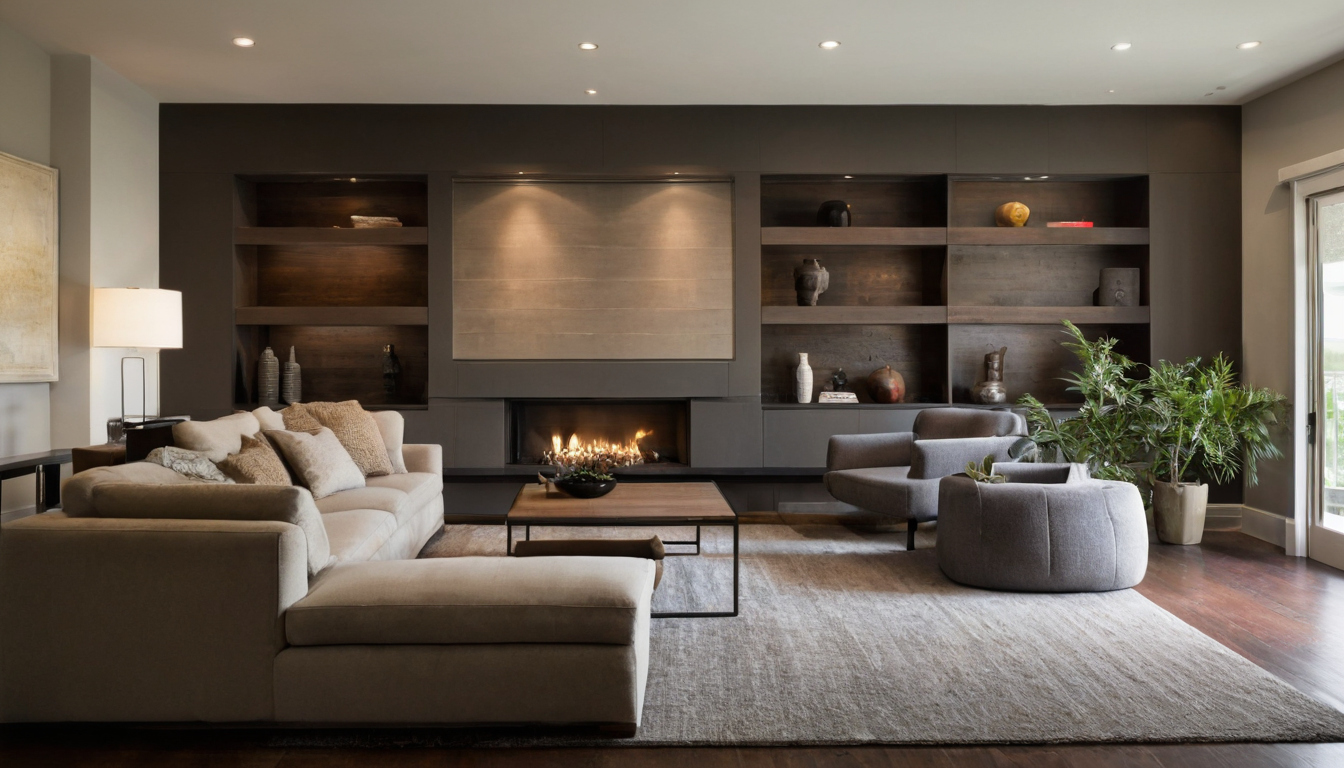
Choose large living room walls decor by proportion before choosing a style shown with floor, wall, and fixture relationships visible.
Measure the usable rectangle
- Measure clear width after curtains, windows, columns, radiators, speakers, door swings, grilles, thermostats, switches, outlets, sconces, and access panels.
- Keep controls reachable rather than hiding them behind art, slats, or shelving.
- Check damp exterior walls before wallpaper, fabric panels, or closed shelving backs. The EPA recommends drying water-damaged areas within 24 to 48 hours to reduce mold risk.
- Allow ventilation and curing time for adhesives, paints, sealers, and panel finishes because the EPA says many VOC concentrations are higher indoors than outdoors.
Match the wall treatment to the room zone
A sofa or console wall usually needs one composition about two-thirds to three-quarters of the furniture width. A fireplace wall needs symmetry or a deliberate offset. An open-plan wall may need several zones instead of one oversized gesture. At 8 ft ceilings, keep the composition lower; at 9 to 10 ft, allow taller art or paneling.
Large artwork works best when the living room already has a clear furniture anchor
Large artwork is usually the cleanest walls decor choice when a sofa, console, fireplace, or pair of chairs already defines the centerline.
Artwork should relate to furniture width
A reliable range is about two-thirds to three-quarters of the sofa, console, mantel, or sectional width, with the bottom of the frame typically 6 to 10 inches above furniture when head clearance allows. A 7 ft sofa often needs art around 56 to 72 inches wide; a 9 ft sofa can take one large canvas, diptych, or triptych.
Gallery walls need a controlled grid
A gallery wall needs one clear rule: a shared centerline, a strong outer rectangle, or a datum line along the top or bottom. Keep frame spacing consistent, often 2 to 4 inches, and limit frame finishes in already busy rooms.
Heavy frames, acrylic glazing, canvas stretchers, and multi-panel works need fixing checks. In older homes, avoid invasive preparation until materials are understood; the EPA advises that asbestos-containing material in good condition and not being disturbed is usually best left alone in its asbestos guidance.
Built-in shelving is the right large wall solution when storage, display, and structure justify the cost
Built-in shelving suits a large living room wall when the household needs books, equipment storage, display depth, or architectural balance, not just ornament.
Design shelving around load, span, and fixings
Shelf design starts with the heaviest realistic use. Books load a shelf far more than ceramics or photographs, so a library wall needs shorter spans, thicker material, and more support than a display niche. The USDA Wood Handbook is an engineering reference for wood and wood-based products, but final dimensions should follow hardware ratings and the installer’s fixing plan.
Wall substrate decides the fixing method. Timber studs, masonry, concrete, and metal studs need different anchors or backing. Base cabinets reduce cantilever risk and create a level datum for consoles, modular wall systems, and high-end furniture anchors, including pieces discussed in Italian furniture brands for luxury interiors.
Media shelving needs cable routes, access panels, and air space around amplifiers, routers, and game consoles.
Open shelves need negative space
Open shelving works as walls decor only when the elevation has breathing room. Keep heavy books low, handled objects between waist and shoulder height, and some bays empty.
Mirrors enlarge a living room only when they reflect depth, daylight, or a controlled view
Mirrors work on a large wall only when they reflect a window, garden view, chandelier, or layered seating area rather than glare, clutter, a television, or a blank ceiling.
Test reflections before fixing
Tape the proposed mirror outline on the wall, then test the reflection from seated and standing eye height. A mirror opposite a garden view can brighten a deep room; a mirror opposite a harsh west-facing window can create glare. Test again after sunset, when lamps and picture lights can become bright spots.
Mirror walls need safety backing and anchoring
Mirror weight sets the fixing strategy. As a broad guide, 4 mm mirror glass weighs about 10 kg per square metre, while 6 mm mirror glass weighs about 15 kg per square metre before frame, backing board, or hardware is added.
Bonded mirror panels need a flat substrate, compatible mirror adhesive, safety backing film where specified, and mechanical retention. U.S. safety rules for architectural glazing are addressed in 16 CFR Part 1201, but local code and installer guidance should decide the specification.
Paneling, slats, plaster, wallpaper, and fabric panels should be chosen by permanence and maintenance
Architectural finishes suit a large living room wall when the room needs texture, acoustic control, vertical correction, or a more permanent accent wall design idea.
Use direction to adjust proportion
Vertical timber slats, narrow applied moulding, and tall veneer panels help an 8 ft ceiling feel more upright. Align slats, panel breaks, or moulding bays with the sofa, fireplace, console, or window edges. Wide rooms with 9 to 10 ft ceilings can take larger panels or broader plaster fields. Horizontal boards make the wall feel longer, so use them only when width is an asset.
Permanent finishes need a stronger reason
Wallpaper is usually more reversible than Venetian plaster, timber slats, stone veneer, porcelain slabs, or glued acoustic panels, but removal still depends on substrate and adhesive. Grasscloth can fade, stain, and show seams. Timber slats collect dust, while MDF moulding dents at chair-back height.
For U.S. homes built before 1978, the EPA’s Renovation, Repair and Painting Rule applies to covered renovation work and requires lead-safe work practices.
Stone panels and stone fireplace walls need a maintenance plan. The Natural Stone Institute recommends cleaning stone with a neutral cleaner, stone soap, or mild liquid dishwashing detergent and warm water.
Lighting decides whether large wall decor looks intentional or flat
Lighting should be planned before finalizing large living room walls decor because artwork, mirrors, shelving, and textured panels all react differently to beam angle and glare.
Choose the beam for the surface
Artwork usually benefits from adjustable accent fittings or picture lights aimed to cover the frame evenly. Textured plaster, stone, timber slats, and fabric panels need a different approach: grazing exaggerates relief, while wall washing smooths the surface. Mirrors, glossy frames, glass glazing, polished stone, and televisions should be checked from the sofa so bare lamps, downlights, or window reflections do not land in the eye line.
The safest large living room wall plan follows a measure, mock up, light, fix, then finish sequence
A large living room wall should be planned in sequence: measure the usable wall, map furniture and eye levels, mock up the composition, confirm lighting, check fixings, then order materials.
Mock up before ordering
Painter’s tape is the cheapest design tool in the room. Mark the outside size of the artwork, mirror, shelving bay, or panel field, then add paper templates for frame edges, shelf thickness, and gaps.
- Photograph the mockup from the sofa, lounge chairs, entry, dining edge, and hallway.
- Check the centerline against seated eye level, not only standing height.
- Compare one large piece, a grid, a mirror, shelving, and a full-wall finish before ordering.
Check substrate and services before installing heavy decor
Locate studs, masonry, metal framing, pipes, cables, weak plaster, and previous patching; a stud finder alone is not enough for oversized mirrors, stone panels, or loaded shelves. Use qualified trades for new wiring, built-ins, large mirrors, and plaster finishes. The final decision should be the least-permanent treatment that solves scale, glare, storage, and fixing safely.
FAQ
What is the 2/3 rule for wall art above a sofa or console?
The artwork or grouped frames should be about two-thirds of the furniture width below. Two-thirds to three-quarters often looks more connected than art sized to the whole wall.
What is the 70/30 rule in art and does it apply to living room walls decor?
Let one visual element dominate and another support it, such as 70 percent calm wall field and 30 percent art, shelves, mirror, or texture.
How do you arrange paintings on a large living room wall without making it look cluttered?
Use a controlled outer rectangle, consistent spacing, and one shared centerline or datum tied to the sofa, console, or fireplace.
What is the 3-5-7 rule of decorating and is it useful for shelves or gallery walls?
Odd-numbered groupings can help shelves and small clusters, but spacing, scale, and a clear grid matter more on a large wall.
Should a large living room wall use one oversized artwork, several frames, a mirror, shelving, or paneling?
Choose artwork when furniture anchors the wall, frames when the grid is controlled, a mirror when the reflection helps, shelving when storage justifies structure, and paneling when a permanent finish solves proportion or texture.